A highlighter tile that works behind a café counter can fail on a greasy restaurant floor or a hospital pantry wall. The right choice depends on the project’s traffic, cleaning routine, moisture, heat, visibility, and the exact zone where the tile will be installed; by the end, you will be able to assign suitable tile types to each commercial setting and prepare a specification that suppliers can verify.
Key takeaways
- Use glossy or embossed tiles on feature walls, not high-traffic floors.
- Specify separate tiles for backsplashes, preparation zones, wash areas, and floors.
- Compare slip resistance, water absorption, chemical resistance, and cleaning effort.
- Approve a full tile sample, grout joint, batch, and written specification before ordering.
Match the highlighter tile to the commercial project and its visible zones
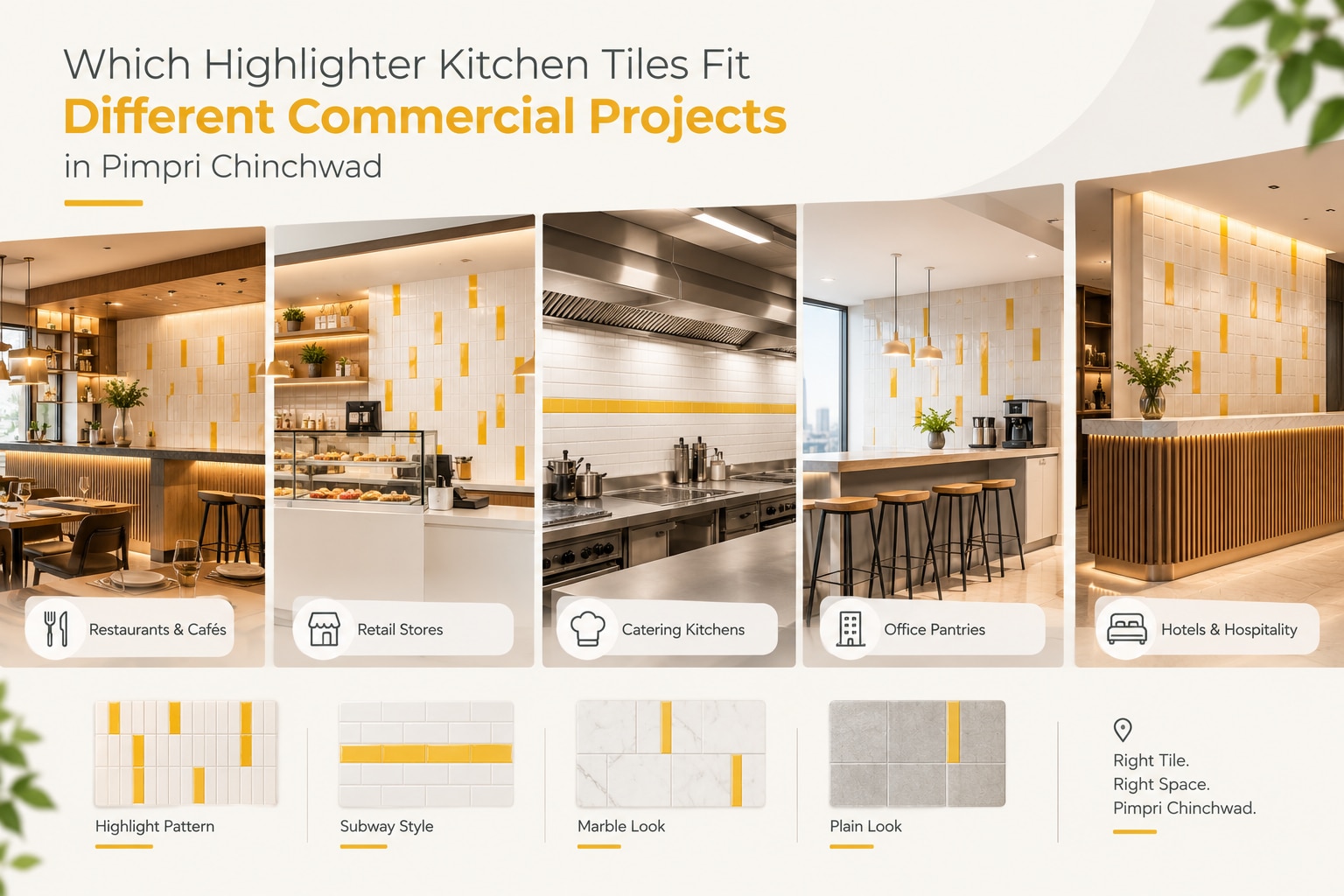
A customer-facing wall can carry visual detail; a customer-facing floor cannot. For which highlighter kitchen tiles fit commercial projects in Pimpri Chinchwad, treat glossy, metallic, glass, deeply embossed, and three-dimensional tiles as feature-wall or backsplash products, not traffic-floor tiles. Relief traps grease and makes mechanical cleaning harder.
| Project | Visible zone | Suitable highlighter tile |
|---|---|---|
| Restaurants | Dining-room feature wall or cooking-line backsplash | Shallow-relief satin or smooth glazed tile |
| Cafés | Counter front, menu wall, or beverage backsplash | Small-format glossy or glass tile away from impact points |
| Hotels | Lobby accent, breakfast-counter backsplash, or guest-floor feature wall | Coordinated decorative tile with restrained relief |
| Offices | Reception backdrop, café wall, or pantry splashback | Low-relief tile in a quiet colour or geometric pattern |
| Hospitals | Reception accent or visitor café backsplash | Smooth, non-porous, easily wiped tile; avoid deep texture |
| Schools | Cafeteria serving-wall accent or entrance feature | Durable, smooth tile with simple grout detailing |
| Cloud kitchens | Customer pickup wall or order-collection counter face | Satin tile with minimal joints and shallow relief |
| Retail food counters | Service-front fascia or display backsplash | Stain-resistant decorative tile; keep worktops and floors practical |
For highlighter tiles for commercial interiors, approve a physical mock-up with the field tile. Check shade, caliber, gloss, relief, edge profile, grout colour, warm lighting, daylight, and cleaning with the planned degreaser. Record the lot number and retain spare tiles; a mismatched replacement creates a visible patch.
Separate decorative backsplashes from preparation, washing, and floor surfaces
Use a highlighter tile on a feature wall or backsplash where appearance matters and direct traffic is limited. Do not approve it for a floor because a supplier calls it “heavy duty”; request the intended-use classification, breaking-strength data, abrasion result, and slip-resistance test.
| Zone | Suitable specification | Avoid |
|---|---|---|
| Decorative backsplash | Smooth or satin-glazed tile with shallow relief, tight joints, and stain-resistant grout | Deep grooves, crackle glaze, open texture, or heavy faceting behind cooking and washing points |
| Preparation or washing wall | Smooth, non-absorbent, readily cleanable ceramic or porcelain wall tile | Three-dimensional, metallic, glass, or deeply embossed highlighter tile that traps grease and obstructs inspection |
| Commercial floor | Porcelain with the manufacturer’s tested absorption value, slip rating, abrasion data, and impact performance | A wall highlighter with no meaningful floor-slip rating, regardless of its marketing claim |
For wet or heavily trafficked floors, porcelain is usually the stronger choice; the manufacturer’s tested water absorption should meet the porcelain classification of 0.5% or less. Ceramic wall tile can suit a backsplash where impact and traffic are lower, but the word “porcelain” alone is not evidence.
Specify practical commercial kitchen tile options for areas that receive food residue, detergents, trolley wheels, or standing water. At a backsplash, keep joints away from the main splash zone where possible, use compatible water- and stain-resistant grout, and seal the wall-to-counter or wall-to-equipment junction with flexible sealant rather than rigid grout alone.
Compare commercial tile options by performance, not appearance alone
Approve a tile from test data, not the “heavy duty” label. Among commercial kitchen tile options, porcelain with a manufacturer-tested water absorption of 0.5% or less is normally the safer floor choice; ceramic wall tile can suit lower-impact backsplashes.
| Check | Require | Reject or question |
|---|---|---|
| Water absorption | Tested percentage and intended-use classification | A wall highlighter offered for wet floors without absorption data |
| Slip | Slip-resistance result for the actual finish, including wet use | No floor rating, especially for polished or glossy surfaces |
| Abrasion | Wear rating or abrasion data matched to foot traffic and trolley use | Decorative glaze with no wear information in a busy route |
| Impact | Breaking strength and impact suitability for the installation | Thin or fragile tile near dropped cookware, carts, or equipment |
| Chemical resistance | Written compatibility with degreasers, acids, solvents, bleach, and alkaline cleaners | Crackle-glaze, metallic, mirror, or glass tile without cleaning restrictions |
| Heat | Resistance to the planned temperature and thermal shock near cooking equipment | Tile or glaze that can crack beside hot lines or during rapid cooling |
| Cleanability | Smooth, non-absorbent face; maintenance sheet; grout that can be scrubbed and inspected | Deep relief, open pores, or a dense grout network trapping food soil |
“Stain-resistant” does not cover every commercial chemical. A supplier must confirm the cleaner list in writing. In preparation and washing zones, choose a smooth surface that cleans quickly; decorative relief can fail that test even when the tile itself resists water.
Choose finish, pattern, grout, and format for faster cleaning
Choose a smooth or satin glaze, shallow relief, a mid-tone colour, and a format large enough to limit joints without creating difficult cuts. This gives highlighter tiles for commercial interiors fewer ledges for grease, dust, and detergent film to collect.
Reserve deep grooves, crackle glaze, metallic faces, mirrors, and heavily faceted patterns for low-contact decorative zones.
| Option | Cleaning and maintenance trade-off | Best use |
|---|---|---|
| Light, uniform colour | Shows splashes quickly but makes residue easier to locate | Back-of-house walls and frequently wiped counters |
| Dark or high-contrast pattern | Hides some stains but reveals limescale, grout discolouration, and fingerprints | Dry decorative backsplash areas |
| Smooth or satin finish | Wipes clean with less retained residue than textured faces | Restaurant and café wall splashbacks |
| Deep relief or open texture | Traps grease and needs repeated brushing | Feature strips away from preparation zones |
| Large-format porcelain | Reduces grout length but requires flatter substrates, controlled lippage, movement joints, and skilled handling | Broad commercial walls where cutting and access are manageable |
Rectified edges do not justify zero-width joints. Use the tile manufacturer’s joint width and grout system; movement, thermal change, edge variation, and installation tolerances still need space. Select grout colour for cleaning visibility, then test it with the planned degreaser.
Approve a physical mock-up before ordering. Check shade, caliber, gloss, relief, edge profile, grout colour, daylight and warm lighting, and cleaning results. For crackle, metallic, mirror, or glass tiles, obtain written cleaner restrictions; stain-resistant does not mean acid-, solvent-, or high-alkaline-resistant. Avoid polished or lappato surfaces on greasy, wet floors.
Approve a commercial tile sample and supplier specification before ordering
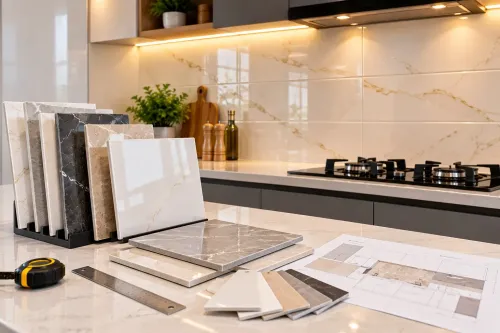
Approve a physical mock-up and a written specification before you release the purchase order. A catalogue image cannot show how relief, gloss, grout, and shade will look beside the selected field tile under restaurant lighting or daylight.
1. Ask the kitchen tile supplier in Pimpri Chinchwad for the manufacturer, collection name, shade code, caliber, finish, dimensions, lot number, tested water-absorption value, and recommended joint width. “Porcelain” alone is not enough; record the manufacturer’s tested figure.
2. Inspect a full-size mock-up with the actual field tile, grout colour, edge trim, and planned lighting. Wipe it with the planned degreaser and check whether grease remains in relief, metallic surfaces, crackle glaze, or mirror details.
3. Require a written maintenance sheet. Confirm whether the tile needs sealing and whether acidic, abrasive, solvent, or high-alkaline cleaners are prohibited. “Stain-resistant” does not mean chemical-proof.
4. Confirm stock and replacement control. Record the approved lot, order quantity, cutting allowance, delivery condition, and the number of spare tiles to retain. Ask how long matching stock will remain available and how the supplier handles a shade or caliber mismatch. Shreya Marble should be assessed on this traceability, not catalogue range alone.
Reject the order if the delivered cartons lack matching shade and lot information, the sample differs from the approved mock-up, or the supplier cannot provide cleaning and replacement terms in writing. A discontinued highlighter can turn one damaged backsplash into a visible patch repair.
Related product
 | Kitchen Tiles Elevate Your Kitchen with Statement Style Highlighter tiles are the ultimate secret weapon for creating an impactful, custom-designed kitchen... View product → |
Frequently asked questions
Which highlighter tiles suit different commercial projects in Pimpri Chinchwad?
Use decorative glossy, metallic, glass, embossed, or three-dimensional tiles for feature walls and backsplashes. Select durable, slip-resistant commercial tile options for floors and work zones.
Can decorative highlighter tiles be used in preparation and washing areas?
Use them only where their surface can withstand grease, water, detergents, and repeated cleaning. Avoid deep relief and porous finishes behind busy preparation or washing areas.
What should you compare besides the tile’s appearance?
Compare water absorption, slip resistance, chemical resistance, abrasion durability, stain resistance, edge quality, cleaning effort, and the manufacturer’s technical specification.
How do finish, grout, pattern, and format affect commercial cleaning?
Smooth surfaces, restrained patterns, rectified formats, fewer joints, and stain-resistant grout reduce grease traps and shorten routine cleaning.
What should you approve before ordering commercial kitchen tiles?
Approve a full-size sample with the proposed grout, finish, lighting, and installation layout. Record the tile code, size, batch, technical ratings, quantity, and replacement availability.
Keywords